
FOR IMMEDIATE RELEASE
March 2026 | Source: Market Research Future (MRFR)
Powered by Teletherapy Expansion, AI-Driven Mental Health Platforms, and Surging Demand for Accessible Digital Care
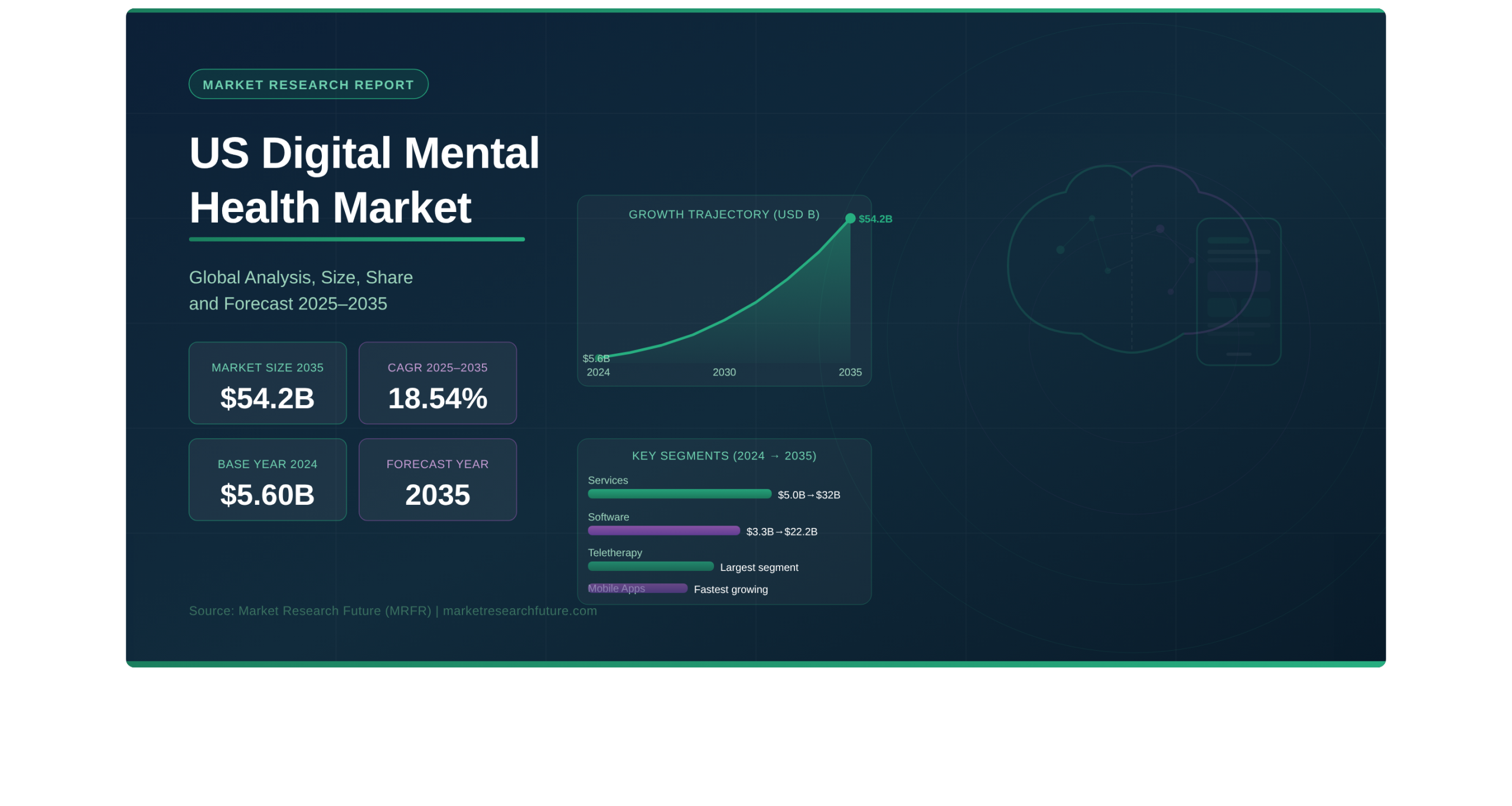
Pune, India — The US Digital Mental Health Market is on an exceptional growth trajectory, according to the latest US Digital Mental Health Market report published by Market Research Future (MRFR). Valued at USD 5.60 billion in 2024, the market is projected to grow at a remarkable compound annual growth rate (CAGR) of 18.54% from 2025 to 2035, reaching USD 54.2 billion by 2035. This explosive expansion positions the US as the world’s most advanced and investment-intensive digital mental healthcare ecosystem — a trend that resonates strongly with the broader Longevity Market size narrative, where mental wellness has emerged as a defining pillar of healthy aging and life extension strategies worldwide.
US Digital Mental Health Market Summary
The US Digital Mental Health Market encompasses a wide spectrum of technology-enabled solutions designed to prevent, diagnose, monitor, and treat mental health conditions through digital platforms. This includes teletherapy and online counseling services, mental health mobile applications, AI-powered chatbots and virtual therapists, digital therapeutics (DTx), wearable mental wellness devices, and clinical decision support software for mental healthcare providers.
According to MRFR analysis, the US Digital Mental Health Market size reached USD 5.60 billion in 2024, with the Software component valued at USD 3.34 billion and the Services component at USD 5.0 billion. By 2035, the Software segment alone is projected to reach USD 22.16 billion, while Services are expected to expand to USD 32.0 billion — reflecting a fundamental shift in how Americans access, receive, and manage mental healthcare. The market sits at a powerful intersection of healthcare, technology, and social awareness, driven by growing recognition that mental health is as critical as physical health in determining overall quality of life.
Request Your Sample Copy of This Strategic Report:
https://www.marketresearchfuture.com/sample_request/17784
US Digital Mental Health Market Growth Factors
The US Digital Mental Health Market growth is underpinned by a convergence of clinical necessity, technological innovation, and shifting cultural attitudes toward mental wellness:
- Rising Mental Health Awareness and Reduced Stigma: The post-pandemic era has fundamentally altered how Americans approach mental health. With COVID-19 dramatically increasing rates of anxiety, depression, and burnout, millions of Americans turned to digital platforms for mental health support — accelerating mainstream adoption of teletherapy, mental health apps, and digital wellness tools in a way that no prior decade achieved.
- Expanding Teletherapy Acceptance: Teletherapy has become the largest and fastest-normalizing care delivery mode in the US digital mental health space. Convenience, affordability relative to in-person therapy, and the removal of geographic barriers have made telehealth-based mental health consultations a preferred choice for patients across demographics.
- AI and Machine Learning Integration: Artificial intelligence is transforming the US digital mental health landscape through automated mood tracking, natural language processing-powered therapy chatbots, predictive risk assessment tools, and personalized treatment recommendations. These innovations are improving both accessibility and clinical outcomes while reducing the burden on an understaffed mental health workforce.
- Employer and Insurer Investment in Mental Wellness: US employers are increasingly recognizing the productivity and retention impact of employee mental health. Corporate wellness programs now routinely include mental health app subscriptions and digital therapy benefits, creating a large, institutionally backed demand channel for digital mental health solutions.
- Supportive Regulatory and Reimbursement Frameworks: Expanding Medicare and Medicaid coverage for telehealth mental health services, along with FDA pathways for digital therapeutics, is creating a more favorable reimbursement environment that is incentivizing both investment and clinical adoption.
🛒 Buy Now Premium Research Report –
https://www.marketresearchfuture.com/checkout?currency=one_user-USD&report_id=17784
US Digital Mental Health Market Trends
Several defining trends are reshaping the competitive and clinical landscape of the US Digital Mental Health Market through 2035:
- AI-Powered Therapy Platforms as Mainstream Care: Platforms such as Woebot and similar AI-driven solutions are moving beyond supplemental tools to become primary care entry points for individuals with mild-to-moderate anxiety and depression. This trend is democratizing access to evidence-based cognitive behavioral therapy (CBT) techniques at unprecedented scale.
- Mental Health App Gamification and Engagement: Developers are embedding gamification elements — streaks, rewards, progress visualization — into mental wellness apps to drive sustained user engagement. This approach is proving particularly effective among younger demographics including adolescents and young adults, who represent a rapidly growing user base.
- Integration of Mental Health into Primary Care Digital Ecosystems: Digital mental health tools are increasingly being embedded into broader electronic health record (EHR) and primary care platforms, enabling seamless referrals, collaborative care models, and integrated patient data for holistic health management.
- Virtual Reality Mental Health Therapy: VR-based exposure therapy for PTSD, phobias, and anxiety disorders is gaining clinical traction in the US, with multiple FDA-cleared VR therapeutics entering the market. This segment, while nascent, represents one of the most transformative long-term growth vectors.
- Focus on Geriatric and Pediatric Mental Health: Consistent with Longevity Market growth themes around aging population care, the geriatric age group (above 65) is emerging as the fastest-growing end-user segment for digital mental health solutions, driven by rising rates of cognitive decline, depression, and social isolation in older adults. Concurrently, adolescent mental health platforms are experiencing surging demand.
US Digital Mental Health Market Segment Analysis
The US Digital Mental Health Market is segmented across component, disorder type, age group, and end user, each revealing distinct growth dynamics that contribute to the overall US Digital Mental Health Market share:
By Component, the market is divided into Software and Services. Software, valued at USD 3.34 billion in 2024 and projected to reach USD 22.16 billion by 2035, is the dominant component, encompassing mental health apps, digital therapeutics platforms, AI chatbot solutions, and clinical decision support tools. Services, encompassing teletherapy, online counseling, and professional digital mental health consultation services, are projected to reach USD 32.0 billion by 2035 — the larger absolute figure reflecting the high-value, per-session nature of professional mental healthcare delivery.
By Disorder Type, Mental Disorders (including depression, anxiety, and schizophrenia) constitute the dominant segment, given their high prevalence across the US adult population. Behavioral Disorders represent the fastest-growing segment, driven by increasing diagnosis rates of ADHD, substance use disorders, and eating disorders — conditions well-suited to digital monitoring, coaching, and intervention platforms.
By Age Group, Adults (aged 20 to 65) represent the largest segment, forming the core user base for both employer-sponsored digital wellness programs and direct-to-consumer mental health platforms. However, the Geriatric segment (above 65) is the fastest-growing age group, while adolescent and pediatric mental health platforms are also expanding rapidly in response to a documented youth mental health crisis in the United States.
By End User, Healthcare Providers lead market adoption, integrating digital mental health tools into clinical workflows to expand patient reach and improve care continuity. Patients and consumers directly accessing digital platforms represent the second major end-user segment, reflecting the growing direct-to-consumer mental health economy.
US Digital Mental Health Market Regional Analysis
As a US-specific market report, the MRFR analysis details regional performance across key US geographies while contextualizing the American market within the global digital mental health ecosystem:
The United States commands the largest national share of the global digital mental health market by a significant margin, accounting for the majority of global market revenue in 2024. This dominance is driven by the country’s combination of high mental health awareness, advanced digital health infrastructure, a dense network of digital health startups and venture capital investment, and progressive telehealth regulation. The US is home to the world’s highest concentration of digital mental health companies, including Teladoc Health, BetterHelp, Talkspace, Calm, Headspace, Lyra Health, Spring Health, Modern Health, Ginger, AbleTo, Maven Clinic, Woebot Health, K Health, Uplift Health, and Amwell — all competing within a rapidly expanding but highly fragmented market.
Within the US, the Northeast and West Coast regions — anchored by New York and California — are the most mature digital mental health markets, driven by high population density, high healthcare spending, and tech-forward consumer behavior. The Southeast and Midwest represent significant growth opportunities, particularly as telehealth removes geographic barriers to access for rural and underserved communities.
Globally, the US sits within the broader North American digital mental health market, which consistently holds the largest regional Longevity Market share across healthcare technology segments. Europe represents the second-largest global market, with the UK, Germany, and France leading adoption of digital mental health platforms. Asia-Pacific is the fastest-growing region globally, with mobile-first mental health app adoption surging in markets like India, South Korea, Japan, and Australia — though the US retains its dominant lead in per-capita digital mental health investment and innovation.
Emerging markets across Latin America, the Middle East, and Africa represent the earliest-stage but high-potential growth regions for digital mental health, as smartphone penetration, mental health awareness, and telehealth infrastructure continue to develop rapidly through the forecast period to 2035.
Key Market Players
The US Digital Mental Health Market features a vibrant competitive landscape spanning large telehealth platforms, consumer wellness apps, and enterprise mental health benefit providers. Key players include Teladoc Health, BetterHelp, Talkspace, Calm, Headspace, Lyra Health, Spring Health, Modern Health, Ginger, AbleTo, Maven Clinic, Woebot Health, Amwell, K Health, Uplift Health, and Sana Health. Strategic partnerships with health insurers, employers, and hospital systems — combined with heavy R&D investment in AI and personalization — are defining the competitive battleground in this high-growth US Digital Mental Health Market report segment.
About Market Research Future (MRFR)
Market Research Future (MRFR) is a leading global market research organization providing comprehensive, data-driven analysis across a wide spectrum of industries. For more details or to access the full report, visit: www.marketresearchfuture.com/reports/us-digital-mental-health-market-17784
Contact: info@marketresearchfuture.com | +1 (855) 661-4441