
FOR IMMEDIATE RELEASE
March 2026 | Source: Market Research Future (MRFR)
Driven by Surging R&D Investment, Laboratory Automation, AI Integration, and Expanding Pharmaceutical and Biotechnology Research
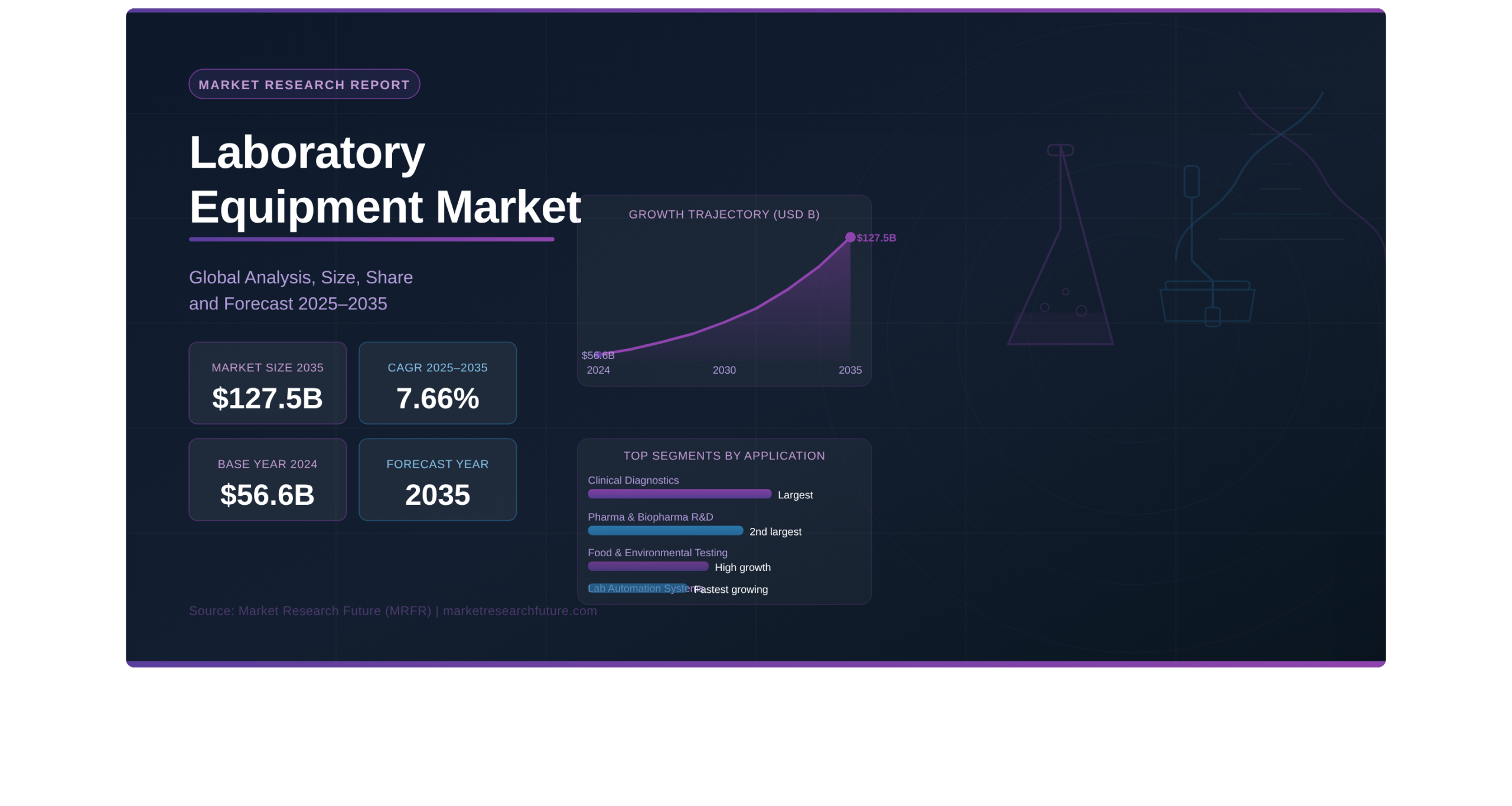
Pune, India — The global Laboratory Equipment Market is on a powerful and sustained expansion path, according to the latest Laboratory Equipment Market report published by Market Research Future (MRFR). Valued at USD 56.60 billion in 2024, the market is projected to grow from USD 60.94 billion in 2025 to USD 127.50 billion by 2035, representing a compound annual growth rate (CAGR) of 7.66% during the forecast period 2025 to 2035. This near-doubling of market value over a decade underscores the pivotal role of laboratory infrastructure in powering global scientific advancement — from drug discovery and clinical diagnostics to genomics, environmental monitoring, and food safety. Much like the Longevity Market size trajectory, where aging demographics are accelerating healthcare investment, the Laboratory Equipment Market is fueled by the convergence of population health urgency, scientific innovation, and increased global R&D commitment.
Laboratory Equipment Market Summary
The Laboratory Equipment Market encompasses the full spectrum of instruments, systems, and tools used in scientific research, clinical analysis, quality control, and experimental investigation across a diverse array of end-user settings. From analytical instruments and chromatography systems to molecular biology platforms, microscopy solutions, centrifuges, incubators, PCR machines, spectrophotometers, and laboratory automation systems, the market represents a vast and technologically diverse ecosystem that underpins virtually every sector of modern scientific inquiry.
According to MRFR analysis, the Laboratory Equipment Market size was estimated at USD 56.60 billion in 2024, with the incubators segment identified as the largest product category due to its high equipment costs and essential, irreplaceable role in biological and pharmaceutical research. The market’s breadth spans clinical diagnostics, pharmaceutical and biopharmaceutical research, academic and government research institutions, food and environmental testing, and forensic science — making it one of the most multi-sectoral and resilient markets in the global healthcare and life sciences industry. The overall Laboratory Equipment Market share is distributed across five key product types, three major application areas, and multiple end-user categories, each contributing distinctly to the market’s robust growth architecture.
Request Your Sample Copy of This Strategic Report:
https://www.marketresearchfuture.com/sample_request/8365
Laboratory Equipment Market Growth Factors
The Laboratory Equipment Market growth is propelled by a confluence of scientific, demographic, regulatory, and technological forces that reinforce long-term, broad-based demand:
- Rising Pharmaceutical and Biotechnology R&D Investment: As drug development pipelines expand — particularly in areas of personalized medicine, cell and gene therapy, biopharmaceuticals, and synthetic biology — laboratories across the world require increasingly sophisticated instruments for sample analysis, molecular testing, and quality assurance. Global healthcare spending is projected to reach USD 10 trillion, further amplifying investment in precision laboratory infrastructure.
- Growing Burden of Chronic Disease: According to the World Health Organization, chronic diseases including cardiovascular disease, cancer, and diabetes are the leading causes of death globally. Cardiovascular diseases alone account for over 17 million deaths annually, creating urgent demand for advanced diagnostic laboratory equipment to support timely, accurate disease detection and monitoring — directly accelerating Laboratory Equipment Market expansion.
- Laboratory Automation and AI Integration: The integration of automation, artificial intelligence, and IoT-enabled systems is transforming the efficiency, accuracy, and throughput of laboratory operations. Robotic systems handling repetitive sample preparation, AI-driven analytical tools, real-time data monitoring platforms, and cloud-based laboratory management systems are all driving new equipment procurement cycles across research and clinical settings.
- Government and Private Research Funding: Increasing research grants from governments and private institutions — particularly for life sciences, genomics, materials science, and environmental monitoring — are supporting laboratory infrastructure modernization worldwide, especially in emerging economies seeking to build competitive healthcare and biotech ecosystems.
- Regulatory Mandates for Testing and Quality Assurance: Rising regulatory requirements for drug development, food safety, environmental monitoring, and quality assurance under frameworks such as FDA 21 CFR Part 11 are mandating the adoption of sophisticated, validated laboratory instrumentation across pharmaceutical, industrial, and clinical settings.
🛒 Buy Now Premium Research Report –
https://www.marketresearchfuture.com/checkout?currency=one_user-USD&report_id=8365
Laboratory Equipment Market Trends
The Laboratory Equipment Market is being reshaped by a set of defining technological and operational trends that will characterize the competitive landscape through 2035:
- Smart Laboratory Ecosystems and IoT Integration: The rapid adoption of IoT-enabled laboratory equipment — capable of remote monitoring, real-time data analysis, and predictive maintenance — is creating intelligent, interconnected laboratory environments that reduce downtime, minimize human error, and maximize research throughput. This shift toward smart lab infrastructure is one of the most transformative trends across all end-user segments.
- Laboratory Automation and Robotics: Robotic platforms and automated sample handling systems are increasingly being deployed to manage high-throughput, repetitive experimental tasks with superior accuracy and speed. Modular and scalable automation systems that can be configured to specific research workflows are gaining significant commercial traction.
- Sustainability and Eco-Friendly Laboratory Solutions: Growing ecological awareness and tightening environmental regulations are driving demand for energy-efficient, low-waste laboratory instruments. Equipment manufacturers are prioritizing the development of sustainable product lines as institutions and procurement managers incorporate environmental criteria into purchasing decisions.
- Miniaturization and High-Throughput Screening: The emergence of miniaturized laboratory platforms and microfluidics technologies is improving productivity while significantly reducing operational costs, reagent consumption, and sample volumes. These solutions are particularly impactful in drug discovery, genomics, and point-of-care diagnostics.
- Strategic Partnerships and Integrated Workflow Solutions: Equipment suppliers, reagent manufacturers, and laboratory software developers are forming strategic partnerships to deliver complete, integrated workflow solutions that address entire experimental processes rather than individual instrumentation needs — a trend that is reshaping the competitive landscape and broadening value propositions across the market.
Laboratory Equipment Market Segment Analysis
The Laboratory Equipment Market share is distributed across product type, application, and end-user segments — each reflecting distinct demand characteristics and growth dynamics:
By Product Type, the market is led by the Incubators segment, which holds the largest share due to the high cost of incubation equipment and its indispensable role across biological, pharmaceutical, and microbiological research applications. Other key product categories include Analytical Instruments — encompassing spectrophotometers, chromatography systems, and mass spectrometers — Centrifuges, Microscopes, PCR Machines, Autoclaves, and Laboratory Automation Systems. Analytical instruments and automation platforms are among the fastest-growing product segments, driven by the push for precision, reproducibility, and efficiency across research workflows.
By Application, Clinical Diagnostics represents the largest application segment, fueled by continuously rising diagnostic testing volumes driven by chronic disease prevalence and aging global populations. Pharmaceutical and Biopharmaceutical Research is the second-largest application area and one of the most dynamic, expanding rapidly due to the global surge in drug discovery, personalized medicine, and biomanufacturing. Additional high-growth application segments include Food and Environmental Testing, Academic Research, and Forensic Science — each driven by distinct regulatory, safety, and scientific imperatives.
By End User, Hospitals and Clinical Diagnostic Laboratories hold the largest end-user market share, driven by high diagnostic testing volumes and increasing adoption of advanced analytical instruments for patient care. Pharmaceutical Companies represent the second-largest and one of the most investment-intensive end-user segments due to their extensive R&D operations. Academic Institutions and Research Laboratories are foundational contributors to market demand, maintaining consistent procurement of specialized instruments. Contract Research Organizations (CROs) and Contract Manufacturing Organizations (CMOs) are among the fastest-growing end-user categories as outsourced research and manufacturing models expand globally.
Laboratory Equipment Market Regional Analysis
The Laboratory Equipment Market regional landscape reveals a mature, dominant position for North America, strong secondary demand from Europe, and accelerating momentum across Asia-Pacific — a pattern that closely parallels the Longevity Market share distribution globally:
North America leads the global Laboratory Equipment Market, accounting for USD 20.54 billion in 2024 and is expected to maintain a significant CAGR throughout the forecast period. The region’s dominance is underpinned by substantial government and private sector research funding, surging grants for schools and private organizations covering laboratory equipment installation and analytical equipment upgrades, well-developed pharmaceutical and biotechnology ecosystems, and a highly sophisticated healthcare infrastructure. The United States is by far the largest single national market, with Canada contributing meaningfully to regional demand.
Europe represents the second-largest regional market, driven by increasing acceptance of the most recent laboratory technologies and a well-entrenched healthcare infrastructure with comprehensive laboratory equipment services including analytical equipment across Germany, France, the United Kingdom, Italy, and Spain. Strong academic research ecosystems, robust pharmaceutical manufacturing, and regulatory harmonization across the EU are key pillars sustaining European laboratory equipment demand through 2035. Strategic investments such as Siemens Healthineers’ Centre of Excellence in Ireland further reinforce the region’s growth trajectory.
Asia-Pacific is projected to register the fastest CAGR from 2025 to 2035, driven by rapidly rising R&D activities, expanding pharmaceutical and biotechnology sectors, growing clinical research infrastructure, and substantial government investment in healthcare modernization. China, Japan, India, South Korea, and Australia are the primary growth markets, with India and China experiencing the most dynamic expansion in laboratory infrastructure installation — particularly driven by the growth of domestic pharmaceutical manufacturing, contract research organizations, and government-backed scientific research initiatives. This mirrors the Longevity Market growth trajectory in Asia-Pacific, where demographic pressure and healthcare investment are accelerating demand across all healthcare equipment categories.
Latin America and the Middle East and Africa represent developing Laboratory Equipment Markets, with Brazil and South Africa serving as regional anchors. Growing healthcare infrastructure investment, expanding diagnostic laboratory networks, and rising awareness of food and environmental safety testing standards are expected to drive steady market penetration through 2035.
Key Market Players
The global Laboratory Equipment Market is served by a highly competitive landscape of established instrumentation giants, specialized equipment manufacturers, and automation technology innovators. Key players as identified in this Laboratory Equipment Market report include
- Thermo Fisher Scientific Inc. (US)
- Danaher Corporation (US)
- Agilent Technologies Inc. (US)
- Shimadzu Corporation (JP)
- PerkinElmer Inc. (US)
- Bruker Corporation (US)
- Waters Corporation (US)
- Mettler-Toledo International (CH)
- Eppendorf AG (DE)
- Bio-Rad Laboratories Inc. (US)
- BD (US)
- Beckman Coulter Inc. (US)
- Revvity
These companies are focusing on strategic collaborations, mergers, acquisitions, and R&D investments to broaden their product portfolios, expand into automation and AI-driven platforms, and capitalize on the robust growth trajectory in both developed and emerging markets through 2035.
About Market Research Future (MRFR)
Market Research Future (MRFR) is a leading global market research organization providing comprehensive, data-driven analysis across a wide spectrum of industries. For full report details, visit: www.marketresearchfuture.com/reports/laboratory-equipment-market-8365
Contact: info@marketresearchfuture.com | +1 (855) 661-4441